The Lost March
A downloadable role-playing game
Fantasy adventure OSR game, inspired on the original 1974 edition and BX. Simple d6 procedures based on the original Fighting Capability system. Designed for a sandbox game, focused on procedural exploration, problem-solving, and minimal dice rolls.
The game is player-centric, in the sense that most challenges are meant to be solved by the players directly, and not by the characters using game features.
- No class levels: characters are assigned a class at creation which establishes lasting initial characteristics, but does not affect their future advancement.
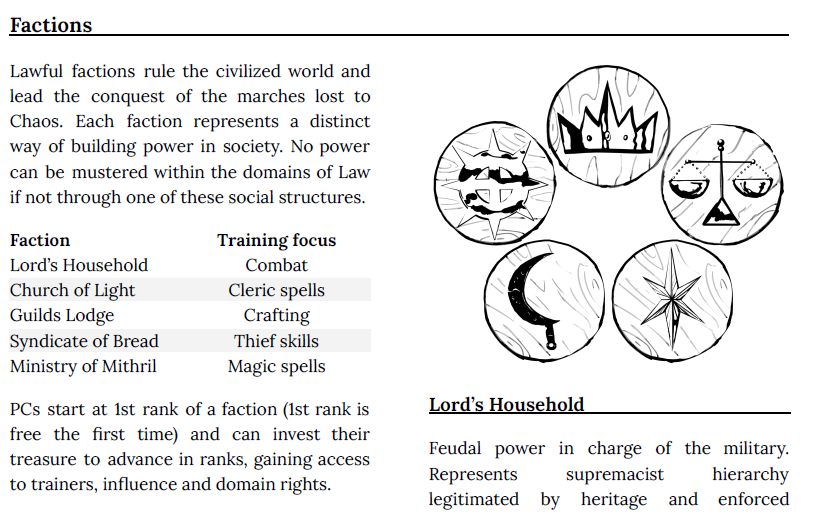
- Advancement: PCs begin as members of one of the Lawful factions. They start at 1st rank, and may advance by investing the amount of gold listed. Factions provide access to specialized training to learn or improve some features. Training is also paid in gold, and takes months of downtime to complete.
- Four Ability scores: Fortitude, Dexterity, Intelligence and Spirit. Strength and Constitution are simplified into Fortitude. Wisdom and Charisma are sorted between Intelligence (all cognitive) and Spirit (emotional and spiritual).
- No hit points: there is no specialized stat for taking damage, most physical damage directly reduces Fortitude ability score, and sometimes Dexterity; other mental or spiritual effects may damage Intelligence or Spirit. Reduced ability scores are used as effective scores. PCs normally recover 1 point of ability score per day of full rest in a safe haven.
- Uniform d6 system: the basic roll is 1d6, a result of 6 is a success, and a 5 is a partial success. This mechanic is used for 3 types of regular procedures: Exploration, Combat and Saves. These skills may be improved to 2d6 and 3d6 depending on the PC’s background, class and further training.
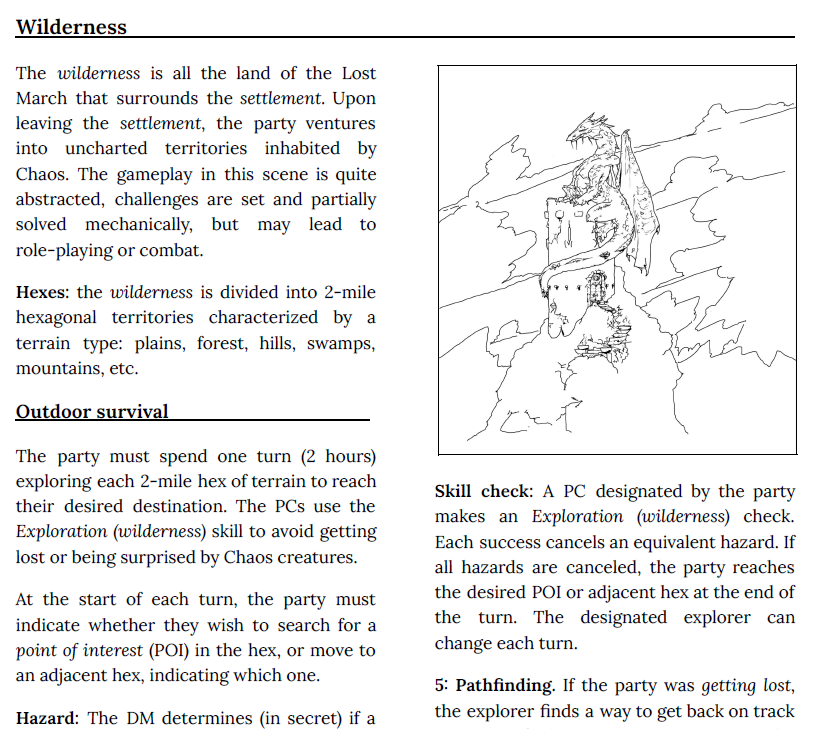
- Exploration: this skill is separated into the three scenes: settlement, wilderness and dungeon. It is checked every turn against the hazard roll of the scene. The party explores the settlement to gather rumors, the wilderness to find the dungeon, and the dungeon to find the treasure and escape alive; then return to the settlement, spend downtime, and repeat.
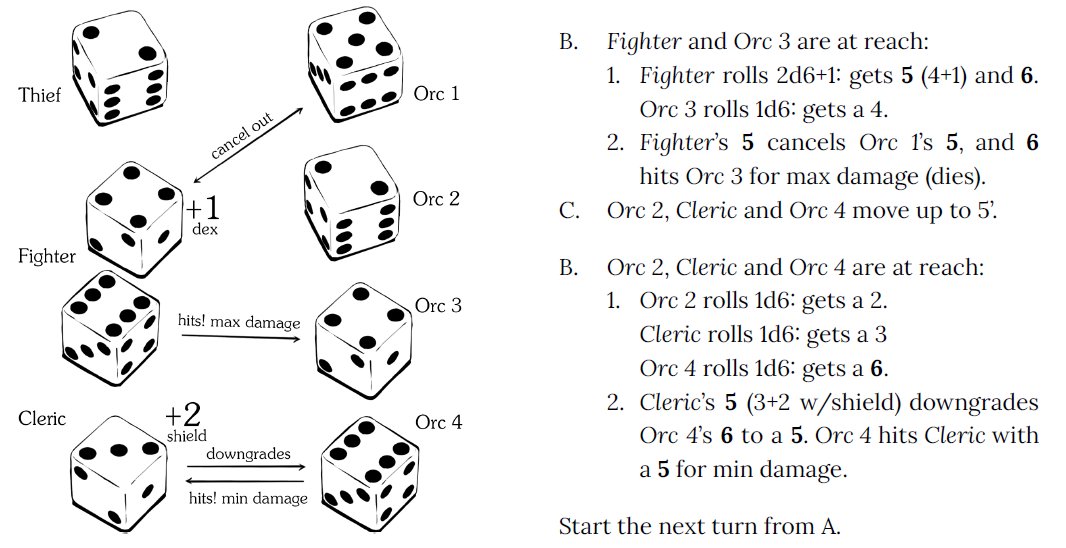
- Combat: this skill is rolled each combat turn, as an opposed check against the enemy’s Combat roll; each success in a d6 is a hit; hits from opponents cancel each other and can be used to deal damage, block or swing from the chandelier.
- Saves: saving skills are rolled to avoid the effects of some imminent hazards PCs triggered; a success in a d6 cancels one effect. Tougher hazards may have multiple effects. Save skills are separated against effects of Area, Poison and Magic.
- Encumbrance: equipment and loot have a load value in coins or slots (1 slot = 100 cs). A PC can carry up to its Fortitude score in slots, so a damaged PC can carry less treasure.
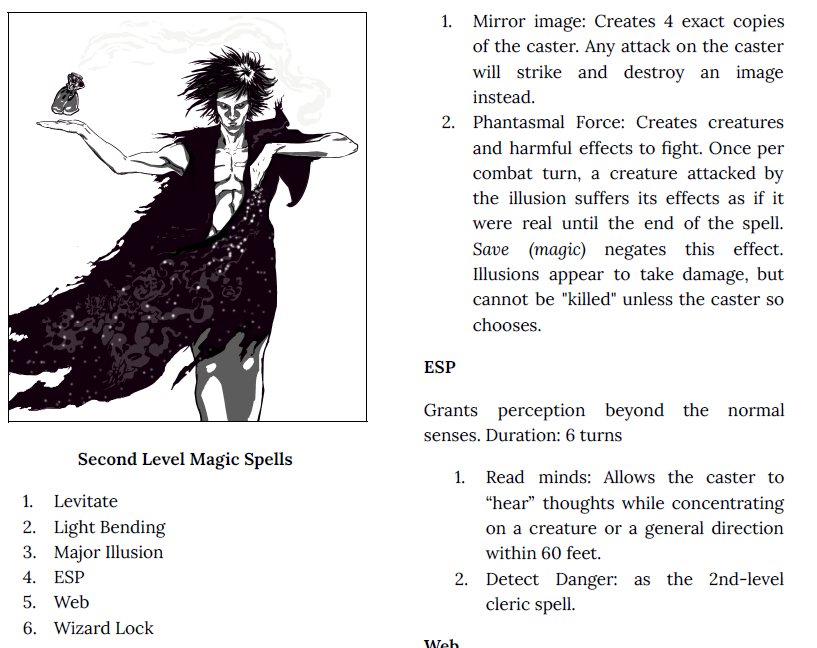
- Vancian magic: spellcasters must prepare their spells through a ritual. They can cast them immediately or memorize them using their Intelligence or Spirit score. Alternatively, a prepared spell can be charged into an attuned focus, such as a wand, ring, or scepter, inscribed on a scroll, or brewed in a potion.
Download
Development log
- Update: layout, art, descriptions and bookmarks86 days ago
- Update: minor typo corrections to beta demoSep 21, 2025

Comments
Log in with itch.io to leave a comment.
Q) Any plans to expand the size of map? I'm using it to run a few adventures in, and it's starting to feel pretty cozy :)
I have the full maps in owlbear, i need to make good quality versions to upload. Here, I'm sharing a screenshot.
Thanks - that detailed map looks great!
It's a neat hack of the old BX stuff. I was originally very confused by what a "Burger" is supposed to be as a player character until it clicked that it's someone from a town.
I like how you've managed to distill things down to d6 rolls - it plays fast and is easy to keep track of. I'm in general not a big fan of having players, not player characters, solve problems, but to be fair, that's just the way that these OSR/BX type games are. Although, it raises the question of stuff like traps - you state that anyone can disarm a trap narratively if they say the right things, but then the Thief also has a specific skill that allows to disarm traps on a roll of 6. There's a couple other dissonances like this in the book in my opinion.
The faction based advancement system is something I've only encountered in a few other games - it's really inspired and I think you've managed to differentiate the factions enough to make it interesting and a worthwhile choice for players.
Combat seems pretty straightforward, but I really wish it wasn't at the end of the book, way after settlement, wilderness, dungeons, underworld and foes. While reading the weapons and armour section, I'd want to know how combat works so I can know what choices to make.
The general sandbox nature of the game is apparent and I'm surprised by how much useful tips and info you've managed to cram into a 49 page book.
Hey! Thank you for your feedback here and reddit. I agree with you that the system is better suited to a sandbox campaign than a one-shot.
I found myself more than once explaining that "burger" is in the medieval sense, and not in the modern capitalist sense. Maybe I should change it to urban?
About traps and such, just like in BX narrative and mechanical resolutions are not mutually exclusive. Any player can disarm a trap if they say the right things, but if you play the thief you may get a chance that the PC solves it for you in a cut-scene. Also, it only works if you find something mechanical to mess with, Open locks is not Disarm traps, it has to make sense.
On the other hand, procedures are a convenience tool, we use them when it is not possible or desirable to role-play. But if you and the table want to have a whole session on the settlement talking to faction members to solve a mistery, go with it, use the rolls as a guide.
Thank you for the insight with the Combat section, maybe the initial skills explanation of combat is not enough. The whole thing needs a proper lay-out designer.
Thank you!
This is brilliantly elegant and does exactly what I tried unsuccessfully to do myself with modifying chainmail and od&d.
The faction framework is my favorite. I look forward to writing my own for my setting
Thank you very much!
I'm glad to hear from others looking for the same thing. Personally, I'm satisfied with the adaptation of the Fighting Capability system as a d6 pool and its application to the procedures. I'm interested to know what stood out to you.
Regarding your adaptation for your setting, are you planning to reskin the factions, or hack anything else?
Did a fairly quick read through, but I am genuinely super impressed. Happened to see the name "The Lost March" on reddit just when I was thinking of crafting my own d6 dice-pool osr thing.
If I may ask, what exactly is yet to come? As the project is clearly listed as a beta. Is it content for the implied setting or more system-side things? Cheers.
Thank you, Im really glad. I am in talks with another designer from the community to work on a better edited and more complete version of these rules, maybe do some publishing. Later, i'd like to work on a setting, chaos and domain supplement and a few modules.
I'd love to have some feedback if you give it a try.
I see, well I'll certainly be keeping an eye out for any updates on this project then.
For sure I'll give feedback once I've given it a proper try at the table.
I LOVE the art style!
thanks!